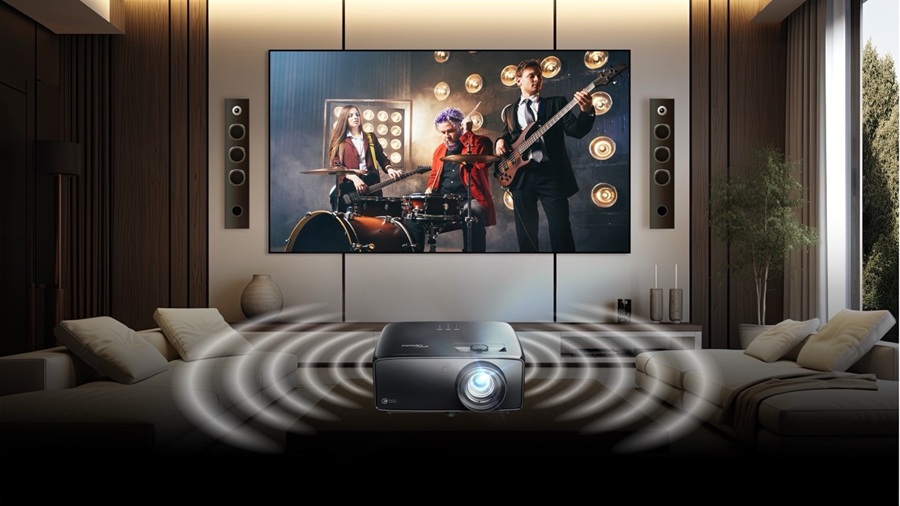
In November 2026 Optoma introduced the P8 and the V8 in China, two laser projectors that succeed the outgoing P5 and V5. One is built for 1080p home cinema, the other for WXGA business and education work. What they share is short-throw optics, a sealed light engine and a maintenance-free laser light source.
One for the living room, one for the meeting room
The difference between the P8 and the V8 comes down to resolution and aspect ratio. The P8 is a 1920×1080 16:9 model covering a 37 to 300 inch image, which suits both living rooms and conference spaces. The V8 is a 1280×800 16:10 model covering 70 to 100 inches, a better match for presentations, spreadsheets and classroom material — a 16:10 panel offers more viewing area at the same diagonal and lines up more naturally with laptop screens.
Brightness is nearly level between the two: 3,500 lumens for the P8 and 3,600 lumens for the V8, both rated to ISO/IEC 21118. That is enough for a living room with the curtains open and a meeting room with the lights on.
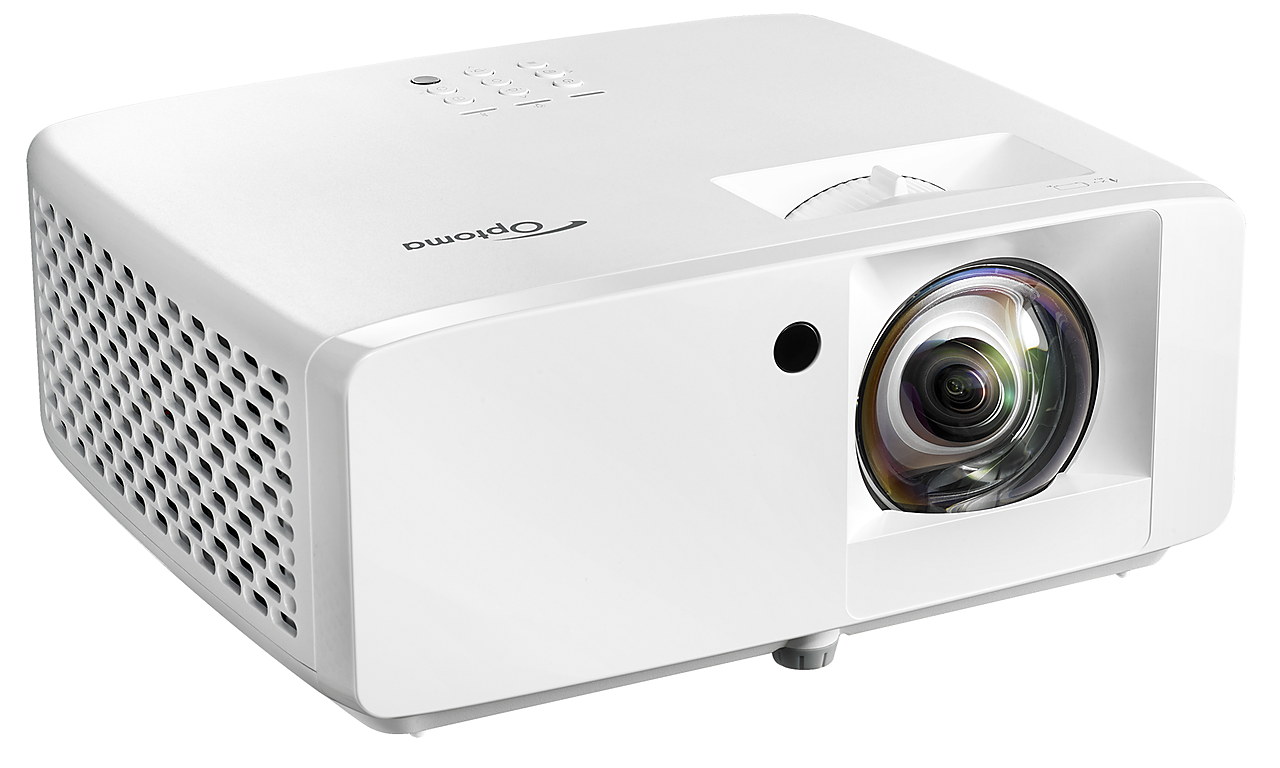
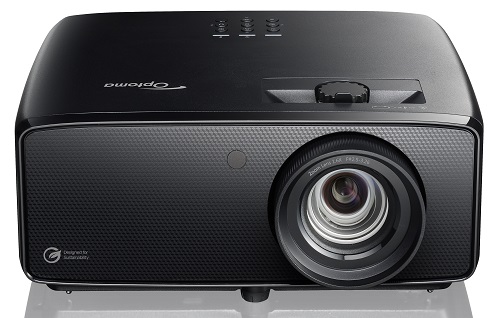
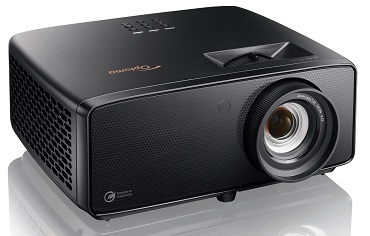
The Optoma P8 and V8 share the same chassis and short-throw optical engine
Short throw: 100 inches from 1.1 metres
The headline specification is the throw ratio. The P8 is rated at 0.496:1 and the V8 at 0.521:1. In real terms: a 100 inch 16:9 image is 2.21 metres wide, so the P8 needs roughly 1.10 metres of distance; a 100 inch 16:10 image is 2.15 metres wide, so the V8 needs about 1.12 metres. A conventional 1.5:1 long-throw projector would need more than 3.3 metres for the same size.
What that changes: in a small flat, the distance from the media console to the opposite wall is often only 2 to 3 metres, where a long-throw projector tops out at 60 to 80 inches. A short-throw unit sitting on the console can fill 100 inches. In a meeting room the projector can stand at the front corner of the podium rather than hanging in the middle of the ceiling.
3,500 and 3,600 lumens with a 300,000:1 contrast ratio
The contrast ratio is quoted at 300,000:1 and dynamic black compensation deepens dark scenes further. Both models accept 4K input and display HDR — a distinction worth spelling out: the native panels are 1080p and WXGA respectively, so 4K refers to signal handling rather than native 4K output. For streaming, Blu-ray and presentation content that is sufficient; buyers who need native 4K should look at Optoma's UHD and UHZ ranges.
Colour is 10-bit with 1073.4 million displayable colours, and colour matching adjustment is retained for consistency across multiple units.
Sealed optics and IP6X: 30,000 hours without maintenance
The P8 and V8 use a fully sealed optical engine with an IP6X dust rating, so no additional dust filter is required. In galleries, classrooms and restaurants that matters more than a brightness figure on a spec sheet — a conventional open-engine projector needs cleaning within a year or so, after which brightness drop and on-screen noise follow.
The light source is Optoma DuraCore laser technology rated for 30,000 hours in Eco mode. At eight hours a day, five days a week, that is about 14 years; at four hours a day it is roughly 20 years. Power consumption is 139W, about half that of a lamp-based projector at the same brightness.
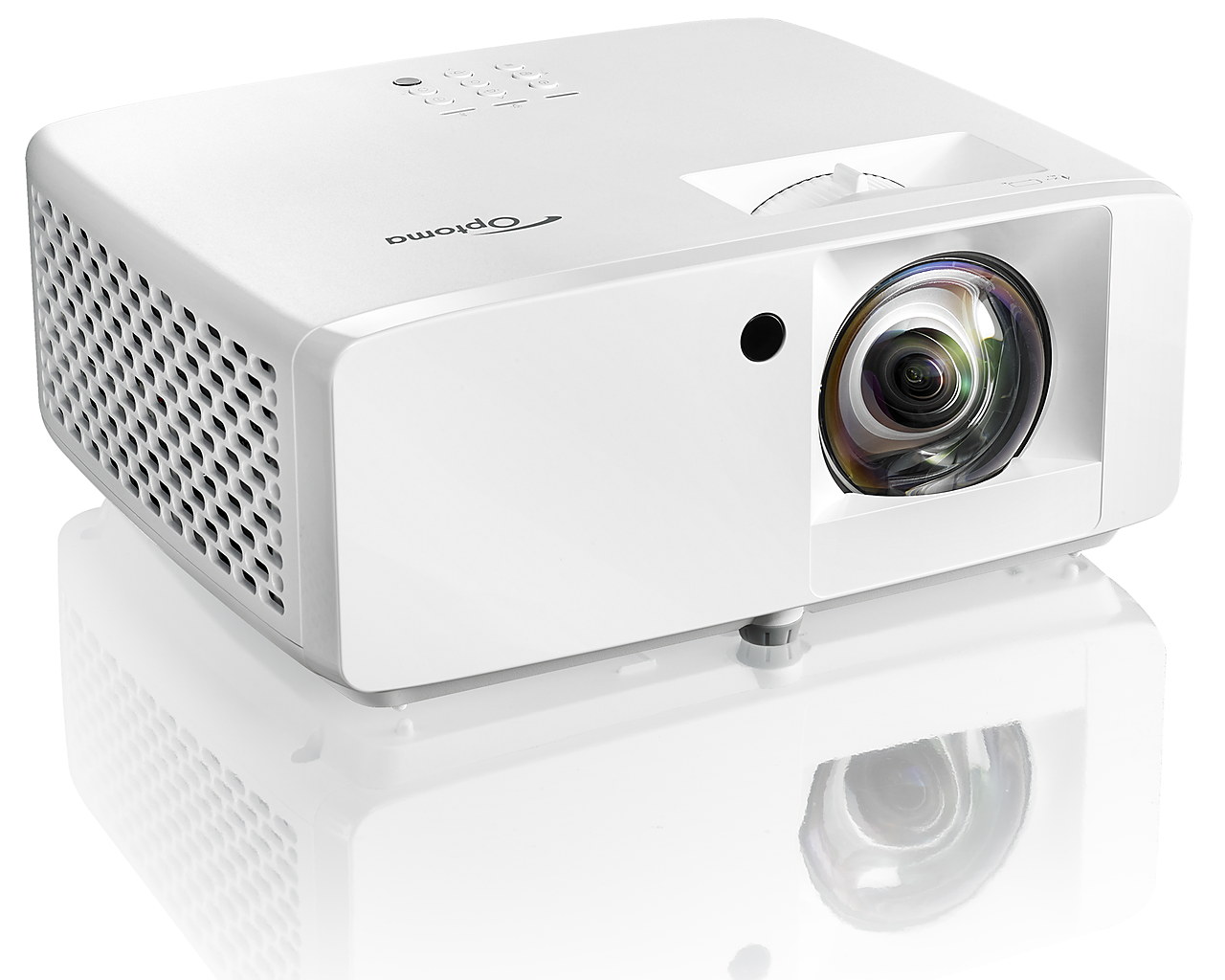
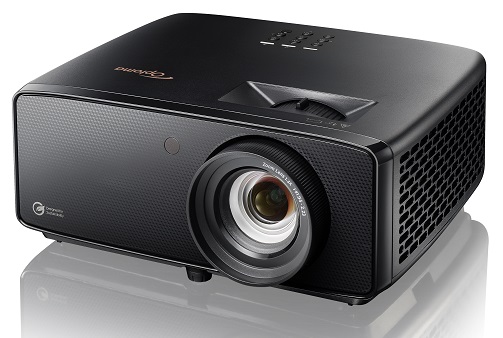
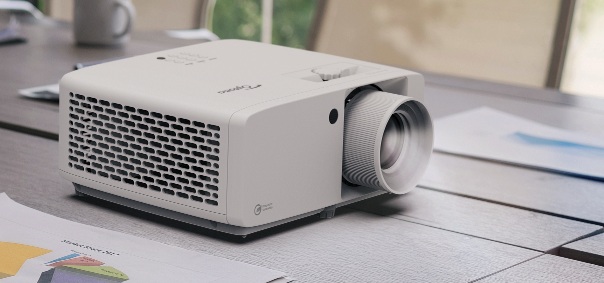
Large ventilation grilles on the side; the sealed engine needs no filter
Installation: 360 degrees, portrait mode and four-corner correction
Both models support 360 degree operation and portrait orientation, so they can project onto a ceiling or be mounted vertically inside a display window or cabinet. Geometry is handled by horizontal and vertical ±15 degree digital keystone plus four-corner correction, adjustable from the on-body buttons or the Optoma Smart Control app.
The chassis measures 274×216×114mm and weighs about 3.2kg without the external power supply, small enough to carry in one hand. The external supply keeps the body lighter and cooler, and is easy to replace later.
Management: one network cable for a whole floor
Optoma Management Suite (OMS) lets an administrator check the temperature, status and operating hours of every projector on the same network from a single dashboard, and switch groups on or off together. Control options cover RS232, RJ45, Crestron, Extron, PJ-Link, AMX and Telnet, so the projectors can join an existing control system.
Two smaller details shape daily use: power-on detection, which starts the projector as soon as a source is connected, and instant on and off. In a meeting room those two matter more than most numbers on the spec sheet.
Specifications
| Item | P8 | V8 |
|---|---|---|
| Display technology | DLP | DLP |
| Native resolution | 1920×1080 (1080p) | 1280×800 (WXGA) |
| Brightness | 3,500 lumens (ISO/IEC 21118) | 3,600 lumens (ISO/IEC 21118) |
| Contrast ratio | 300,000:1 | 300,000:1 |
| Aspect ratio / screen size | 16:9, 37″–300″ | 16:10, 70″–100″ |
| Throw ratio / offset | 0.496 / 115%±5% | 0.521 / 115%±5% |
| Keystone correction | H/V ±15° plus 4-corner | H/V ±15° plus 4-corner |
| Light source / life | DuraCore laser, 30,000 hours (Eco) | DuraCore laser, 30,000 hours (Eco) |
| Dust rating | Sealed engine, IP6X | Sealed engine, IP6X |
| Connections | 2× HDMI, 1× audio out, 1× USB-A, 1× RJ45, 1× RS232 | 2× HDMI, 1× audio out, 1× USB-A, 1× RJ45, 1× RS232 |
| Noise / power | 27dB (Eco) / 139W | 27dB (Eco) / 139W |
| Dimensions / weight | 274×216×114mm / approx. 3.2kg | 274×216×114mm / approx. 3.2kg |
| Installation | 360° and portrait projection | 360° and portrait projection |
Availability
The P8 and V8 went on sale in China in November 2026. Optoma has not yet announced a suggested retail price, so street pricing will be set by dealers. Both sit at the entry end of the company's laser range and replace the P5 and V5; buyers who need more brightness or native 4K should look further up the UHZ line.
A simple way to choose: for a large 16:9 image driven mainly by films and games, take the P8; for 16:10 text clarity and a standard meeting room screen of 100 inches or less, take the V8.